
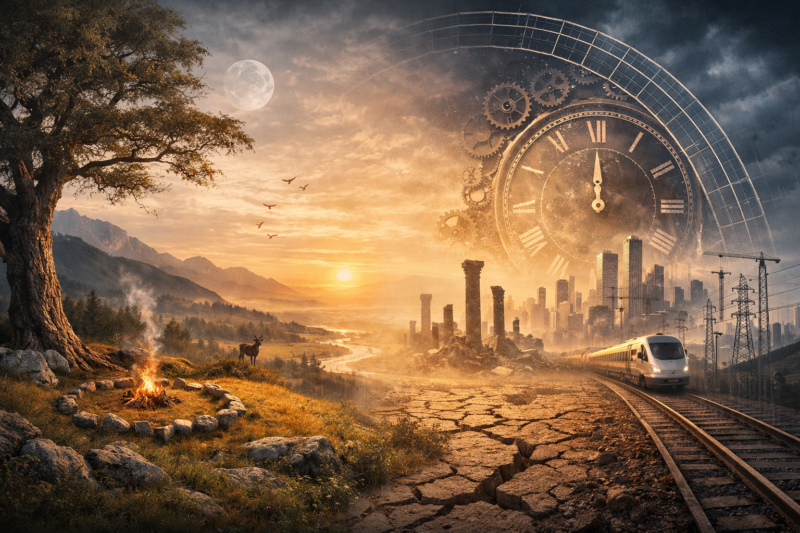
For most of human existence, the future was not a destination. It was more like the weather — something that arrived, departed, returned, surprised, and could not be owned. The modern fixation on “the future” as a project, a promise, or a debt is a recent invention, tightly braided with modernity’s desire for control and prediction.1
To make the future into a destination, time first had to be straightened. Earlier ways of living held time not as a straight line stretching forward, but as a living field of return. Seasons circled back. Stories folded past and future into the present. Decisions were made in conversation with what had come before and with what might echo beyond one’s lifetime. Time was relational and recursive, shaped by land, ceremony, memory, and repetition.
Modernity quietly reorganised this experience. It stretched time into a line, pointed it forward, and named this movement “progress.” In doing so, time became something to be managed, optimised, and extracted from — broken into units, deadlines, growth curves, and futures to be secured. What was once a shared rhythm became a resource, and what was once simply lived became something to get ahead of.
This change suggests that modern futurity functions more like a technology than a truth. The future, as we now tend to understand it, is not an inevitable horizon so much as a cultural artifact — shaped, maintained, and defended within a particular moment in history.
The Future as a Promise of Progress
Modernity needs the future to justify present violence:
- Extraction can be excused because “progress” is coming.
- Sacrifice can be demanded because “later” will be better.
- Harm can be downplayed because it is framed as a necessary step.
In this way, the future came to serve as a kind of laundering machine, washing blood into promise and harm into progress. By projecting responsibility forward, modernity learned how to survive without having to account for its present costs.
Over time, this orientation reshaped everyday habits of thought and feeling. People learned to live toward a future that was always just ahead, while the present became something to endure, optimise, or postpone. Attention drifted away from what was breaking, hurting, or asking for care now, and toward what might eventually be fixed later. This cultivated a strange form of patience — one that could tolerate ongoing harm as long as it was narrated as temporary, necessary, or on the way to improvement. In this sense, modern futurity did not only reorganise economies and institutions; it quietly trained people to live at a distance from the consequences of their own lives.
Learning to Live Elsewhere
Once the future becomes central, it begins to function as a disciplining device, shaping how people are expected to behave in the present. Orientation toward what is “coming” quietly reorganises everyday conduct, training attention, desire, and endurance. Under this logic, the future issues a familiar set of instructions:
- Be patient.
- Work harder.
- Optimise yourself.
- Delay grief.
- Ignore the land’s signals.
In this configuration, the future becomes a leash rather than a horizon, pulling people forward while dulling their capacity to respond to what is already happening. Who benefits from a population trained to live elsewhere — always later and never here and now?
Seen from this angle, modern anxiety begins to look less like a personal issue and more like a symptom of futurity itself. Burnout, climate panic, and compulsive self-optimisation might be read as indicators of our care about the future, yet they reveal how trapped we are inside a narrow and fragile version of it. When the future is imagined as something that must be controlled, saved, and optimised, the possibility of its loss becomes unbearable. What emerges is not care, but a constant state of vigilance, urgency, and exhaustion, as people are asked to carry the weight of a future that was never meant to be held so tightly.
Other Ways of Holding Time
Many non-modern cultures understood time as thick rather than long — layered with presence, memory, and obligation, rather than stretched toward a distant horizon. Responsibility extended backward and sideways, not forward alone. Decisions were made in accountability to ancestors, land, and the unborn simultaneously, rather than sequentially, and the future was not owned so much as consulted, if at all. This could be seen, for example, in agricultural practices attuned to seasonal cycles rather than projected yields, or in decision-making processes that required consultation with elders, stories, and place before action could be taken. In some contexts, important choices were delayed not to optimise outcomes, but to listen — through ceremony, observation, or collective deliberation — for signs of readiness from the land and the community. What mattered was not securing a future, but maintaining right relations across time.
These examples are not meant as prescriptions or ideals. They simply remind us that the modern fixation on the future is neither universal nor inevitable — and thus can be questioned. Other orientations have existed, and still exist, even under pressure. Reshaping our individual and collective modern patterns is demanding, but it may be possible to cultivate a different relationship to time. All the while, the desire to do so is itself formed within modernity’s forward pull — that constant impulse to improve, prepare, secure, and get ahead. Living with the tension of contradictions like these, rather than wanting to resolve them, becomes part of the work.
What if the future is not something to be saved, but something to be met? What might become possible if we stopped holding it hostage, and learned instead how to respond to the present with attention, responsibility, and care?
- Here, modernity does not refer simply to what is modern or recent, but to a particular way of organising life — one shaped by colonial expansion, industrial capitalism, scientific management, and the belief that the world can be known, controlled, and improved through human reason alone. ↩︎